
The life of Sarsfield Patrick Smiddy, 1905 to 1978
Finding Sarsfield
He was remembered for one bad year. He lived seventy-two.
A family record in twelve chapters, researched by his great-great-nephew Hayden
Frontispiece. Engraved for this record after his 1926 newspaper portrait. A year later the Washington Post reprinted that photograph above the word ARRESTED.
What the family kept
The son of an important man went to America, got caught with whiskey, and was disowned. Remembered
The old family view of Sarsfield was that he was a "mess up" and that there was not much thought about him.
That was all of it. No war, no wife, no jokes. A whole life folded into one line, and handed down for almost a hundred years.
Then an old swimming medal came into the hands of a boy.
It all started with his swimming medal, which my grandad gave me, and a story about his "bootlegging" incident in 1927.
His grandad is Professor Eoin O'Brien, a cardiologist and an author best known for his writing on his friend Samuel Beckett. The two of them are very close.
Eoin's mother was Dr Muriel Smiddy, the youngest of Sarsfield's five sisters, which makes Eoin his nephew.
A swimming medal doesn't fit the sentence. Someone trained for it. Someone kept it. So the question passed from a nephew who grew up with the old story to a boy who wouldn't leave it there.
Turn it over and it says more: C.W.C.S.C. Diving Championship. On the front, at the centre of the cross, are two engraved letters: SS. He didn't only swim. He dived, well enough to come home with a medal. The initials may stand for Clongowes Wood College Swimming Club, but that still has to be proved. Open
Asked to sum Sarsfield up in three words, Hayden chose these.
Brave. Forgotten. Fascinating.
Contents
Two threads run down this record. The gold one is Sarsfield's life. The red one is Hayden's search for it. They cross behind each engraved plate. The plates were made for this site with the help of AI. The photographs and records are real, and you can turn on at any time.
II 1905
The only boy
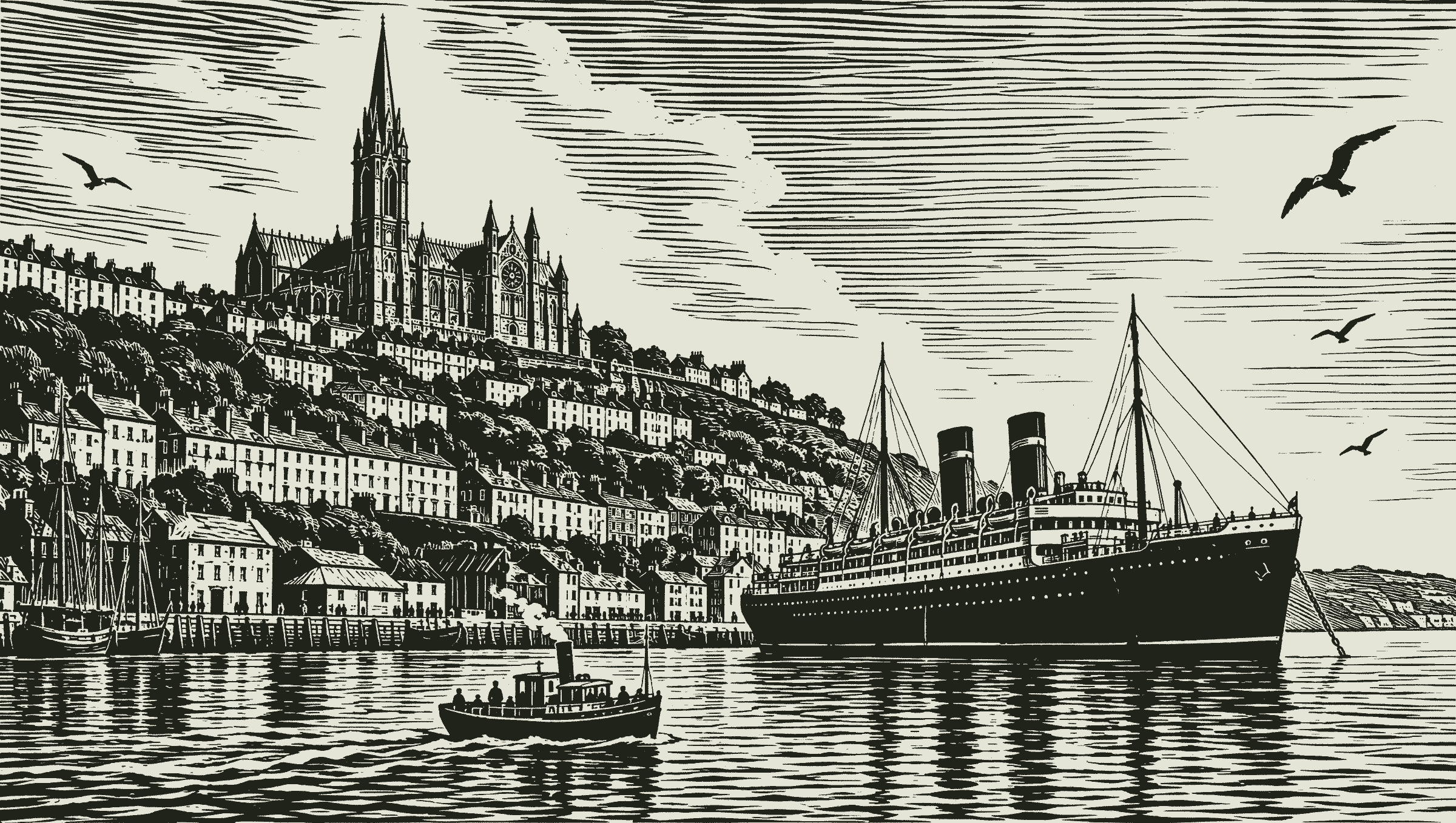
Sarsfield Patrick Smiddy was born in Cobh, County Cork, on 11 October 1905, the third of six children and the only son. Documented
Birth date and place: and the Florida death certificate . Five daughters and a son are also named in the 1962 funeral report .
He grew up with five sisters, Pearl, Muriel, Cecil, Ita and Ethna, and they adored him. His niece Eda Sagarra, who wrote her grandfather's biography, says so directly, and she had their school letters to go on. His mother Lilian was Muddie to the family. His father was Audo. Corroborated
He had a head for machines and he loved motor cars. A list of students in the centenary book of Clonakilty Agricultural College includes "Smiddy Sarsfield" in the 1922 to 1923 group. Corroborated
He also had a father on the rise, and that would shape everything that came next.
III 1922
The first envoy
Timothy Smiddy was very important during Ireland's new freedom, especially after the brutal War of Independence and then the Irish Civil War that very shortly followed.
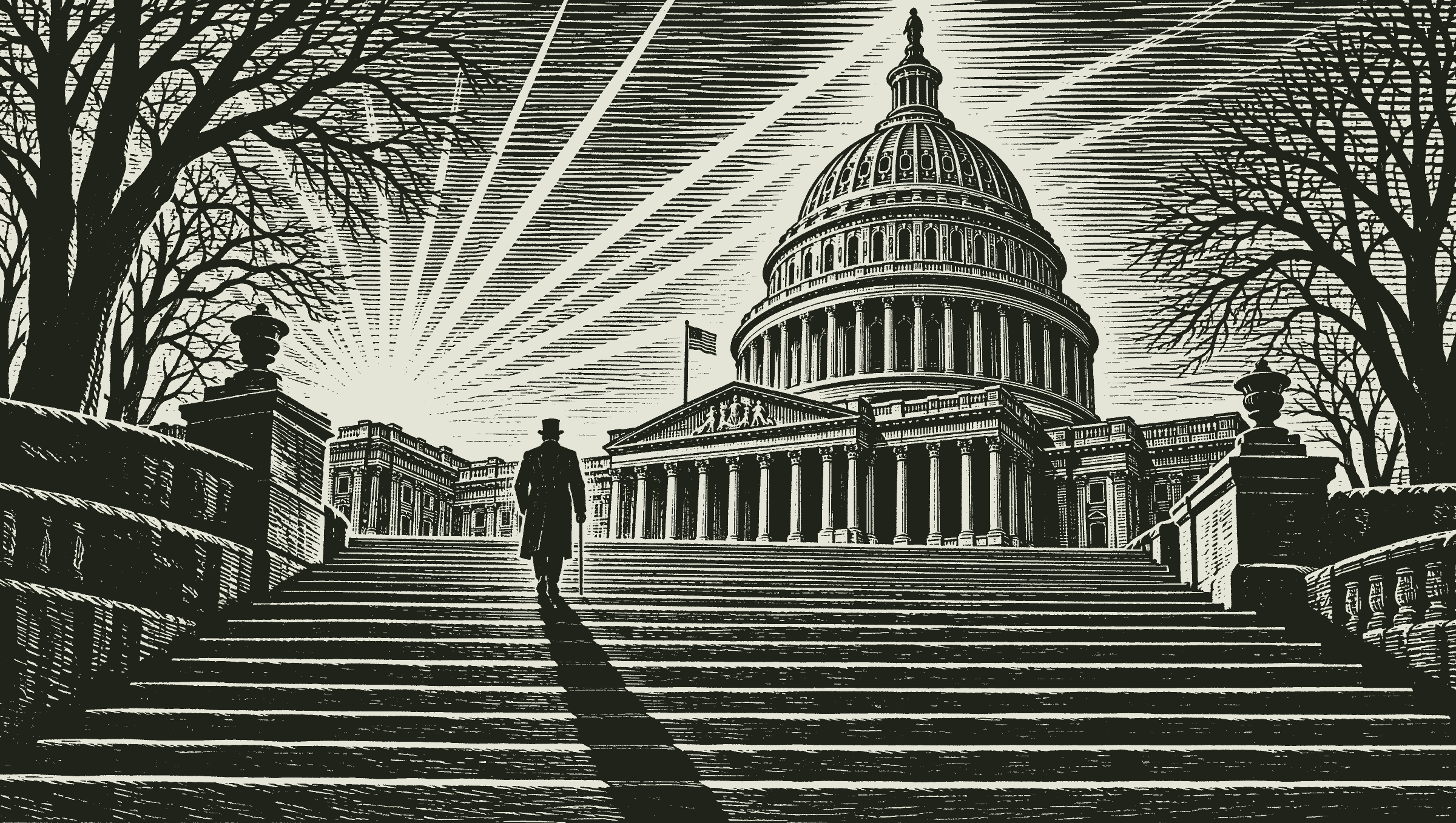
Timothy Aloysius Smiddy was born in Cork on 30 April 1875, a businessman's son. He studied in Cork, Paris and Cologne, became professor of economics at University College Cork in 1909, and was a close friend of Arthur Griffith and Michael Collins. In 1921 he advised the Irish delegates in London at the talks that produced the Treaty. Documented
In March 1922, with independence barely agreed, Collins sent him to America as Ireland's envoy and fiscal agent. It was a hard posting. Civil war was breaking out at home, much of Irish America was against the Free State, and Washington wouldn't formally recognise him at first, because Britain hadn't approved the appointment. He spent years crossing the country, telling Irish communities that the new state was stable and worth believing in. Documented
On 7 October 1924 he presented his credentials to President Coolidge.
He was Ireland's first diplomat, and the first from any British dominion to be accredited to the United States. Today he's often called Ireland's first ambassador. For the first time Ireland could deal with Washington directly, without going through the British embassy. Documented
He brought the family to the Wardman Park Hotel in Washington and stayed until January 1929.
He also had real enemies. The Dictionary of Irish Biography records repeated hostility from parts of Irish America, including attempts to expose his private life, and some thought him too friendly to the British. Corroborated
Dictionary of Irish Biography; Mark Holan's history of the Irish legation; Irish Times, 27 September 2014 ; Ireland.ie centenary material.
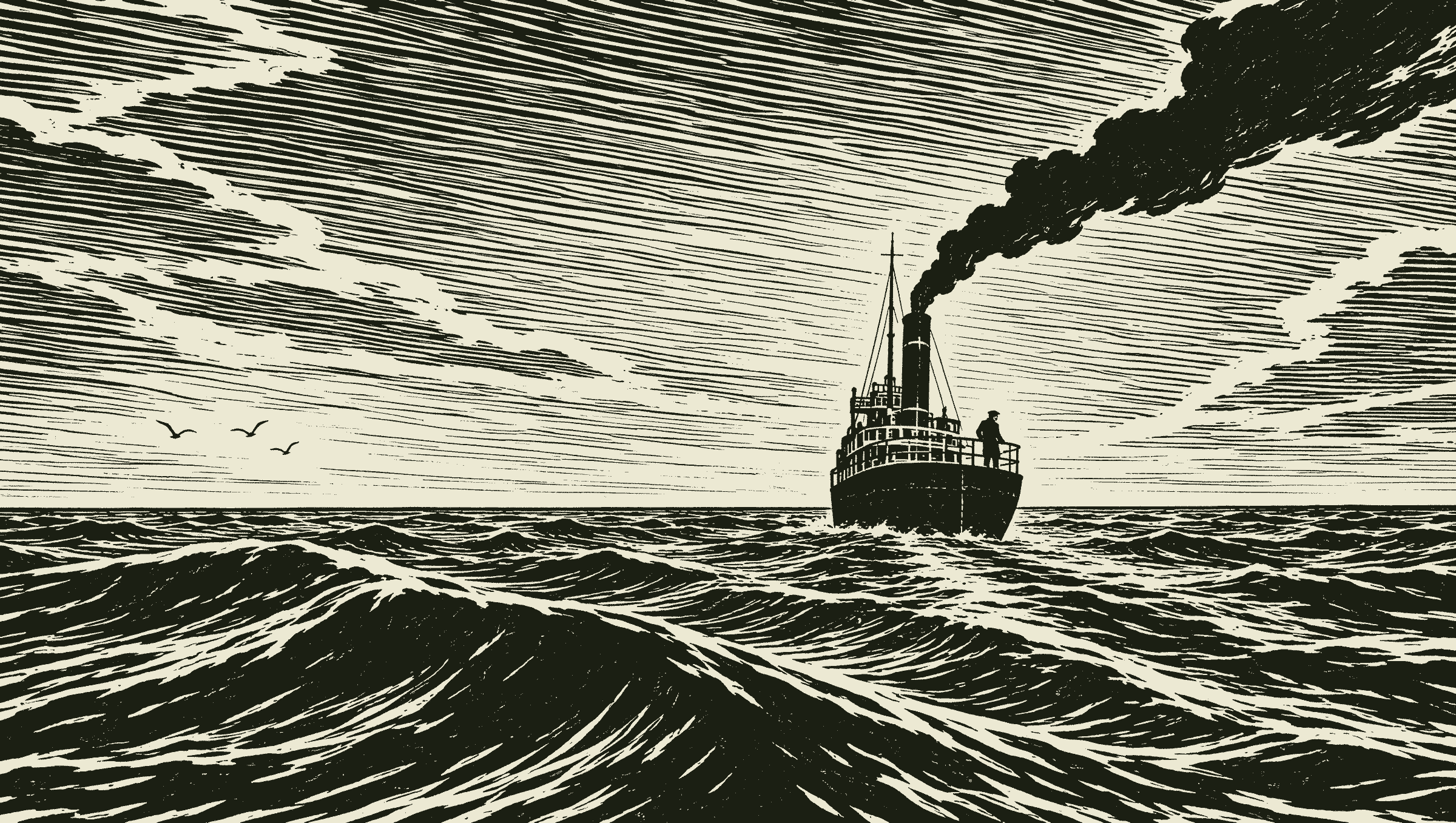
In April 1925, aged nineteen, his only son followed him across the Atlantic. Corroborated He didn't stay in Washington. He went to Detroit.
IV 1925
The stock chaser
Detroit was the place to be for anyone who loved engines, and he took a job at Chrysler.
In June 1926 the Detroit News went looking for him, and the Washington Post reprinted what it found. His father was in Washington winning friends for Ireland. His son, aged 20, had spent the past year on menial tasks in a factory. Documented
He "punches the clock", the paper said, and snatches hasty meals with the other men until the whistle blows. His job was "stock chaser", moving parts from one department to another. He worked "quietly, without ostentation". This was the son of a head of mission.

Then the reporter asked him why, and Sarsfield explained.
"I thought I could learn things here that would add to her agricultural productivity. I still think so, but I have decided industry is more important. Ireland already has agriculture. Of industry she has little."
"First some of her young men must have industrial training, and that's why I am here."Sarsfield Smiddy, aged 20. Washington Post, 29 June 1926
This is the part of him the family lost: a young man from a state barely four years old, who had worked out what his country was missing and gone to fetch it. Hayden's notes say he hoped to bring what he learned back to Ireland. Here he is saying so himself.
He kept in touch, too. The Post's society column notes him twice that year: in April at the Wardman Park Hotel with his parents, visiting for two weeks from Detroit, and in August as the guest of his mother and sisters. The family looks close. Documented
Sources: , , and . Earlier drafts of this project left the employer open between Chrysler and Ford. Sarsfield's own words settle it for 1925 to 1927: Chrysler, first at Highland Park, then at their body plant in Detroit. Family biography: .
Then came a Friday in April.
V 1927
Forty-three bottles
"I was getting the liquor for a party."Sarsfield Smiddy, on arrest
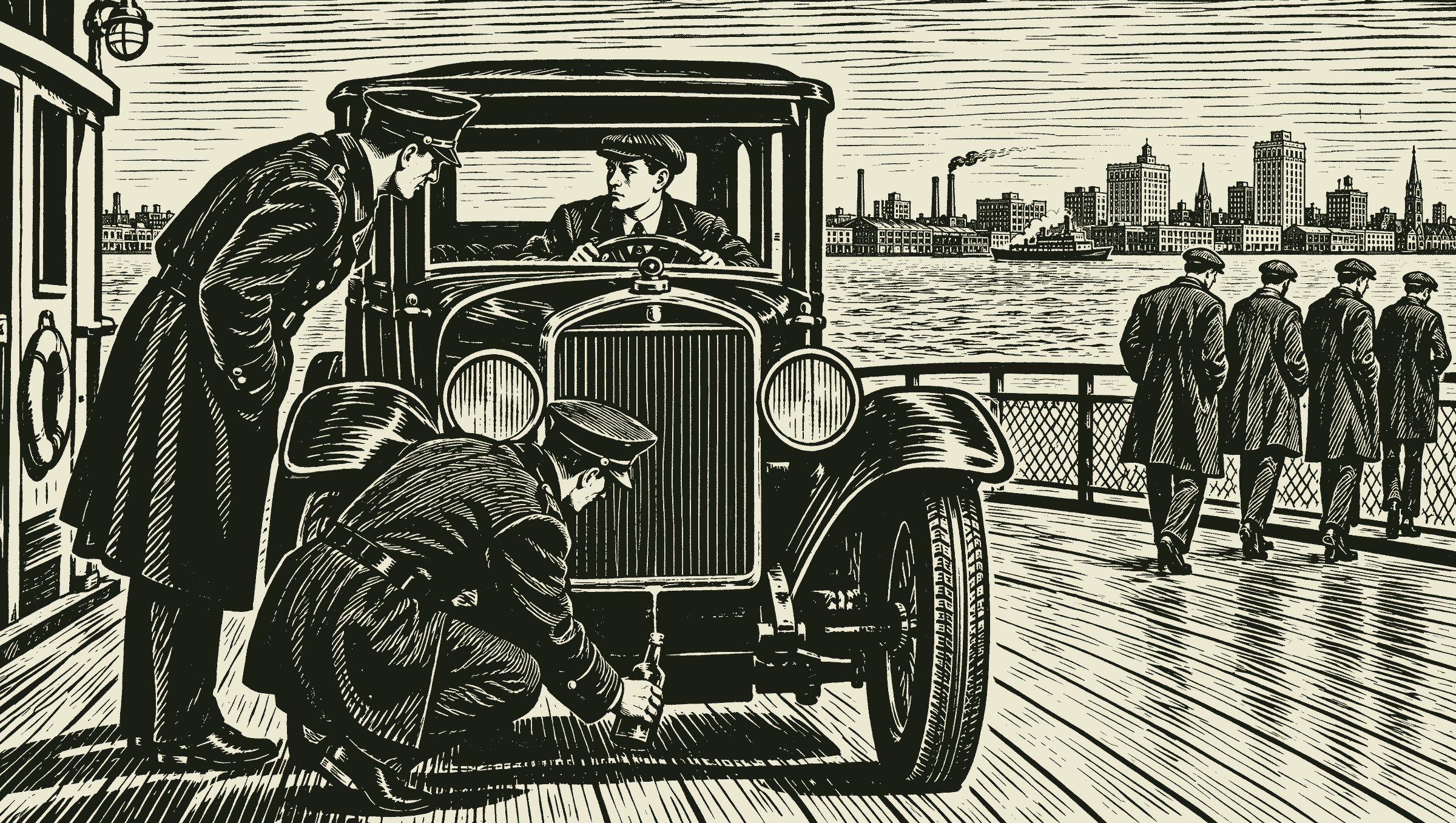
Sarsfield and four friends go over to Canada and buy forty-three bottles of whisky. They pack them under the radiator of a borrowed car and board the ferry for Detroit. Documented
Halfway across, his friends get out of the car. Then one of the bottles starts to leak. Customs officers arrest Sarsfield, and in the confusion his friends get away.
His explanation isn't a gangster's.

It was a clever hiding place
Give them credit. Forty-three bottles is a lot to hide in a car, and they weren't in the seats or the boot. They were packed under the radiator, a hot, awkward space full of machinery. You'd need to know your way around an engine to think of it.
And one of that group had spent two years inside a Chrysler plant. The papers don't say whose idea it was. Open
On 26 April he pleaded not guilty before the US Commissioner. He couldn't raise the $1,500 bail, and went to the county jail to wait for his hearing. His father, reached in New York, said he had heard nothing. The State Department said there was no diplomatic immunity. Documented
Even that week, he told the papers what he had come to America to do.
"I expected to gather enough knowledge of motor mechanics to assist in the motor manufacturing field in Ireland."Sarsfield Smiddy, aged 21. New York Times, 26 April 1927
Nobody was listening. A carload of whisky on a Detroit ferry was never going to be a small thing for this family. It landed on a new state's first envoy, in the capital where he'd spent years building its name. Any young man might have got caught. Only this one's mistake could embarrass a country.
The Los Angeles Times ran it. The Victoria Daily Times ran it in Canada, a paper in Helena, Montana ran it, and two days later it was in the Bombay Chronicle in India. Documented
The Washington Post printed his photograph. Look closely at it.
It's the same photograph. A year earlier the Post had printed that portrait to show a promising young man. Now the paper took it down from the file and put a new word under it.
VI Summer 1927
The part nobody kept
I really think people misunderstood you, and there was much more to you than just "bootlegging".
When Hayden went back and read the 1927 newspapers for himself, he found that the family had kept the arrest and lost almost everything after it, including the ending.
Within a month Sarsfield was out of jail and in Washington. The Post's society column of 19 May lists "Mr. S. Smiddy" among the guests at a reception, next to his sisters Pearl and Cecil, with their mother also named. Nobody was hiding him. Corroborated
He wasn't yet a saint. On 5 June, police stopped a driver on the Connecticut Avenue bridge at midnight, doing thirty-four miles an hour. He gave Sarsfield's name and said he'd left his permit at home. It turned out none was ever issued. The District commissioners wrote to the Secretary of State, and on 17 June it was on the front page. Documented
Notice what else the story says. His mother spoke up for him, and said he'd been back in Washington for about a month. Two months after the arrest, he was with his family. Documented
Hayden's notes add a 22 mph limit and a claim that Sarsfield called himself a legation attaché. These aren't in this article, so they need their own source. Provisional
Then, on 6 August, the case ended. A two-sentence Associated Press report from Detroit appeared at the bottom of page 8 of the Washington Post, under a story about General MacArthur.
The charge was dismissed. The family story never was.
We should be fair. This doesn't prove he was innocent. He said himself that he was fetching liquor. The report doesn't say why the commissioner dismissed the case, and only the court file can tell us. Open
There's a puzzle too. In a 2018 Irish Times article, Eda Sagarra mentions his "prison sentence". The reports found so far show a spell in county jail while he couldn't make bail, then a dismissal, and no sentence at all. Either something else is yet to be found, or the jail stay became a sentence in the family's memory. Disputed
What it does show is the size of the thing. He was 21. He did something foolish with a car full of whisky, in a city where smuggling across the river was common, and his father's job turned it into international news. Sagarra's biography calls it a brief press storm with long family consequences. It doesn't mention the dismissal.
And there the family's story stopped.
VII 1928 to 1941
The empty years
It all started when I typed his name into a WW2 records finder for fun, that I paid for, to search for a different family member.
The sentence has nothing to say about what came after. Then one day, almost a century later, Hayden was looking for a different relative.
"His name, which is very unique, and his location of birth, which was already very strong evidence that it really was Sarsfield!" That was how he knew. The family story he'd been given had no soldier in it.
He went to get the service file, and it wasn't there.

Sarsfield's records were missing, incomplete, and by far the most important record, which is called an O.M.P.F., with photos and detailed information, was destroyed in the 1973 fire.
On 12 July 1973 a fire broke out at the National Personnel Records Center near St. Louis, Missouri. It destroyed about 80 per cent of the records of Army personnel discharged between 1912 and 1960. Somewhere between 16 and 18 million files were lost, and no copies had been made. Documented
US National Archives, "The 1973 Fire, National Personnel Records Center".
So the man the family had forgotten had also been erased by accident, five years before he died.
Most people would stop there. Hayden asked for help on Reddit and contacted the National Archives, the VA and courthouses, looking for anywhere a discharged soldier's paperwork might have ended up.
The biggest breakthrough, somehow finding a copy of his O.M.P.F. in a Michigan courthouse, which was vital for research!
VIII 1942
Pioneer Instructor
This is the page that changed everything: his Enlisted Record and Report of Separation, the form the Army filled in when he left. It's a single sheet, and it describes a man nobody in the family story had met. Documented
Tap a number on the form to read it.
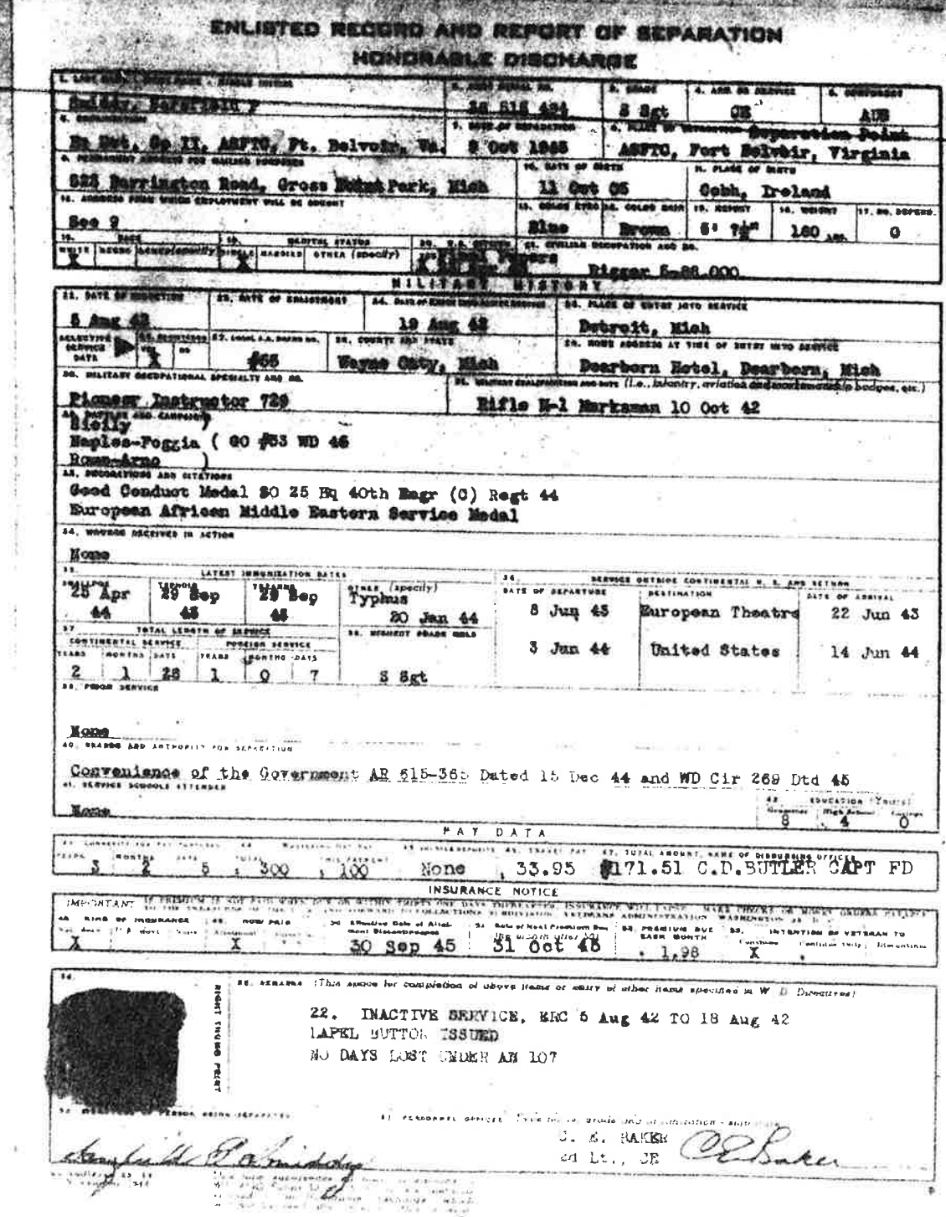
He went into the Army on 5 August 1942, two months before his thirty-seventh birthday. He had no wife and no dependants. He gave his address as the Dearborn Hotel. He was a rigger by trade, a man who moves heavy things safely with cable and tackle. Documented
The arrest was fifteen years behind him. He was older than most of the men around him, and the Army made him a sergeant and an instructor. He went overseas to fight fascism for the country he had made his home, while Ireland, where he was born, stayed neutral.
The official history of the Army's engineers tells us where his regiment went. The 40th Engineer Combat Regiment trained for landings in the United States and reached Oran, Algeria, with the 45th Infantry Division on 22 June 1943. That is the exact date of Sarsfield's arrival on his separation record. Documented
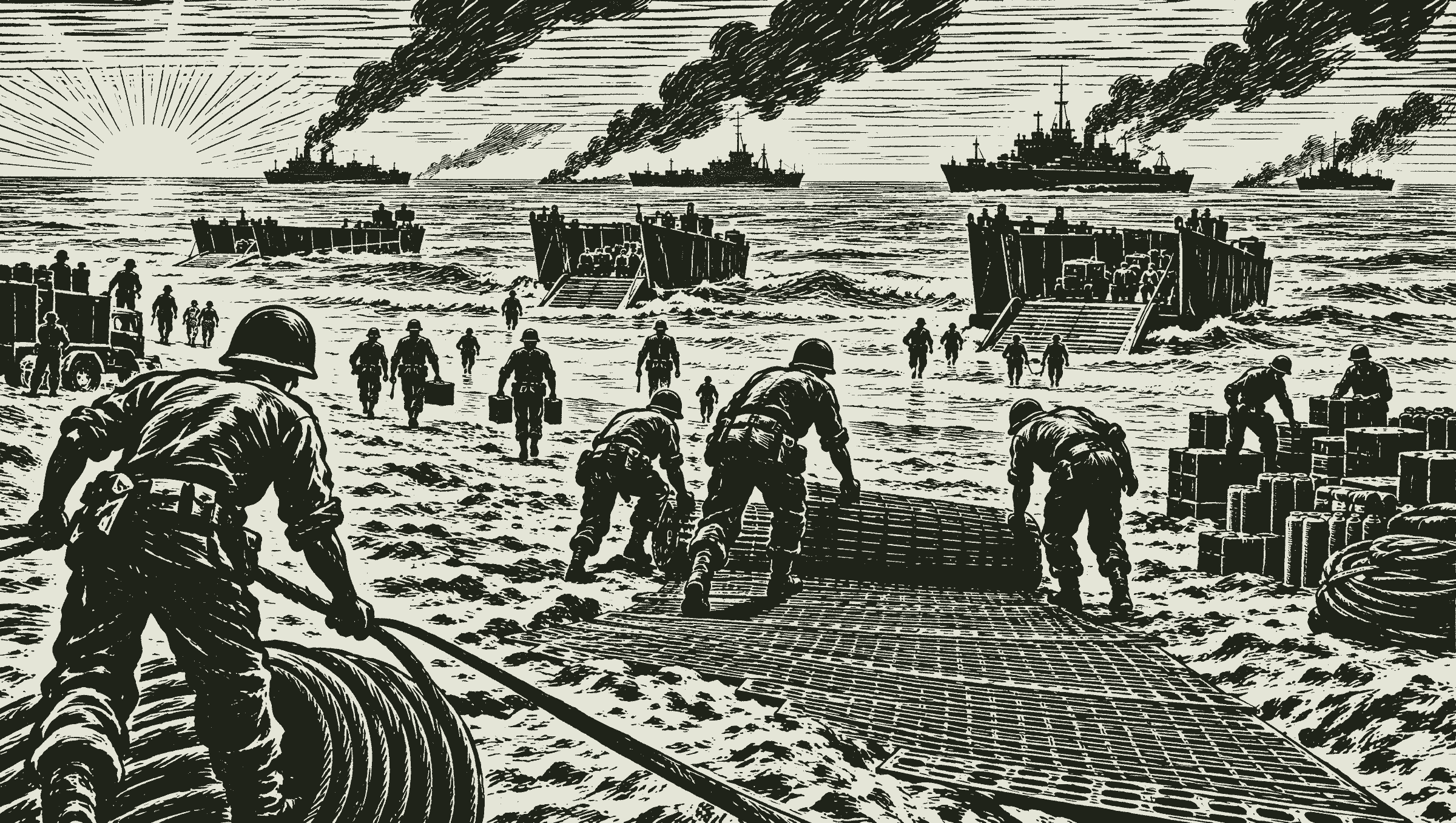
Eighteen days later the regiment went into the invasion of Sicily, as the core of a shore group of about 4,465 men on the Cent beaches near Scoglitti. Shore engineers kept the beaches working. Four men of the 40th won the Distinguished Service Cross there, for helping to take pillboxes that had the beach under fire. Documented
The Corps of Engineers: The War Against Germany, US Army Center of Military History, pages 122 to 134. . The stamp applies to the regiment. It doesn't place Sarsfield or Company I on a given beach at a given hour.
Taking part in the biggest amphibious operation in all of history!Sicily was bigger than Normandy on its first day by some measures, and historians argue about it. Which beach Sarsfield landed on, and when, is still unproven.
We can't yet say where he stood that morning. But the Army has now confirmed his Arrowhead, the mark of an assault landing, and that fits a regiment we can place on an invasion beach. Corroborated His record gives him three campaigns: Sicily, Naples-Foggia and Rome-Arno.
Every Army company filed a report each morning: who was present, who was sick, who had moved. These small cards survived the fire because they were kept separately, and Hayden tracked them down.
In March 1944 Sergeant Smiddy was with Company I of the 40th Engineers near Port aux Poules, on the coast of Algeria. Documented Read together, two cards seem to say that he was hurt on a regimental landing exercise, spent five days with the regimental medics, and went back to work. Provisional
The 5 March entry lists both men with a comma after Smiddy, followed by one remark. That is how clerks usually grouped men in one entry, and the card gives the time as 0430, but a full run of reports would confirm it. The separation record's "Wounds received in action: None" is consistent, because this was training.
Why was a 38-year-old rigger on a landing exercise at all? His Army job was Pioneer Instructor. He may have been teaching younger men how to get ashore. No record says so yet. Open
The most remarkable thing about his service, in my opinion, is his role and the experiences he would have dealt with.
In May 1944 a typed order came through: Sergeant Smiddy was to ship home under the Rotation Plan, the scheme that sent long-serving men back. Documented
He left the theatre on 3 June 1944 and reached the United States on 14 June, after one year and seven days overseas. While he was at sea the Allies landed in Normandy. Two months later his old regiment landed in southern France without him. Documented
Tap a dot on the map.
The map shows his main moves, not every stop. Some places sit close together at this scale: Clonakilty is beside Cobh, and Fort Belvoir is beside Washington.
On 17 September 1945, three weeks before his discharge, he was made Staff Sergeant. He collected his final pay and went home to Michigan. Documented
The last line typed on his form may be the best sentence anyone ever wrote about him.
NO DAYS LOST UNDER AW 107
That means three years and two months with no time lost for misconduct or absence. Then he signed it. For a family with almost nothing of his, here is his hand.
Hayden wrote to the US Army about his missing awards. In June 2026 the Awards and Decorations Branch at Fort Knox answered. After reviewing the record, it had "verified Mr. Smiddy's entitlement" to six awards. Documented
Pure joy, and disbelief when I finally got the letter, which was sent on my birthday, funny enough!
The Army also did something that matters even more. It enclosed a formal correction that amends his 1945 Report of Separation, and it sent the change to the National Personnel Records Center so that his record, lost in the fire, may be rebuilt. More than eighty years after he left the Army, a teenager's letters had changed his file. Documented
Army Good Conduct Medal
By a general order of his own regiment, 1944. The son remembered as a disgrace was decorated for his conduct.
European-African-Middle Eastern Campaign Medal
With three bronze service stars and an Arrowhead for an assault landing. The stars and Arrowhead were added by the Army's correction in 2026.
American Campaign Medal
For his service in the United States. Added by the Army's correction in 2026.
World War II Victory Medal
For his wartime service. Added by the Army's correction in 2026.
Marksman Badge with Rifle Bar
Rifle M-1, 10 October 1942. A badge rather than a medal, and it means he could shoot.
Honorable Service Lapel Button
The "Ruptured Duck", worn on civilian clothes to show a man had served.
Posthumous medals normally go only to the next of kin. Hayden isn't, so the Army put in a charge request that lets him order them himself. Its letter closes "On behalf of a grateful Nation".
The medals have been ordered, and when they arrive they'll be photographed for this record, front and back. Whether Sarsfield ever wore or even kept his own, nobody knows. Open
Four medals, one badge and one lapel button: accurate names matter, and the project avoids calling all six "medals". The ribbons are drawn from the Army's published stripe specifications. The letter is dated 8 June 2026.
IX
Disowned?
He was thought to be an outcast as his father disowned him, after Sarsfield's legal troubles, as it apparently damaged his father's reputation.
This is the hardest question in the story, and the most human. Something clearly went wrong between father and son. Nobody has found a letter that says what.
The word "disowned" has been handed down for generations. Remembered
Some Irish Americans thought Timothy too friendly to the British. Historian Troy Davis has said they used the arrest against him. Corroborated
An American lawyer wrote to the head of the Irish government to say the arrest had shamed the country. The pressure on Timothy was real. Corroborated
Weeks after the arrest he's at a Washington reception with his mother and sisters. Corroborated
He's still in Washington, and his mother speaks up for him in the press. Documented
He writes to Muddie from North Africa. His niece remembers the family's excitement. They hadn't lost touch. Remembered
He visits Ireland to see his mother and sisters. Corroborated
Sagarra records just that one trip home, about 25 years after he left. He built his life in America. Corroborated
Sagarra records that his older sisters still resented how their father had treated him. Corroborated
The Irish Times lists him among his father's chief mourners. Documented
That one line is worth stopping on. The son who had supposedly been cut off was named first among the children, at a funeral attended by the President of Ireland and the Taoiseach. The newspaper doesn't prove he stood at the grave, because the list may simply name the family. If he did travel, he was 56, and Sagarra's "only once" needs correcting. Disputed
Hurt, certainly. Disowned, unproven.
The fairest conclusion today is that Sarsfield has an untold story, and he was often looked on in a negative way by the family, but records and historical evidence say otherwise.

X After the war
The man in the black shirt
He went back to Michigan and back to work. In 1945 the Army wrote down his trade as rigger. In 1978 his death certificate said the same: rigger, heavy equipment. That's more than thirty years of careful, dangerous, physical work. Documented
He married, later than most. Hayden's notes call his wife Berenice. The certificate names her as Florence B. Stevens, so Berenice may be her middle name. Open They moved south to Big Pine Key in the Florida Keys, about as far from a Dublin drawing room as you can get in America. Documented

Uncovering his "new past", which showed a completely different side of him that was quite astounding to me!
For years the family thought only two photographs of him survived. Hayden has found more, and this is the one to remember him by.
That's Sarsfield in the black shirt, with his arm in the air.
Nobody in this room is looking at an outcast. There's a laugh, a raised arm, and people in bright clothes pressed up close together.
His niece Eda met him when she was a student. She wrote to Hayden about it, and what she remembers isn't a scandal. She remembers a small man, very nice, with a grand sense of humour, in pink socks with coloured clicks. Remembered
Sarsfield Smiddy died at the Veterans Administration hospital in Miami on 1 February 1978, aged 72. He was cremated in Miami. Documented
The certificate stays private because it holds medical and identity details. Only these facts are used here.
Nearly half a century later, a young rifle shooter took up his case.
XI Now
The one who went looking
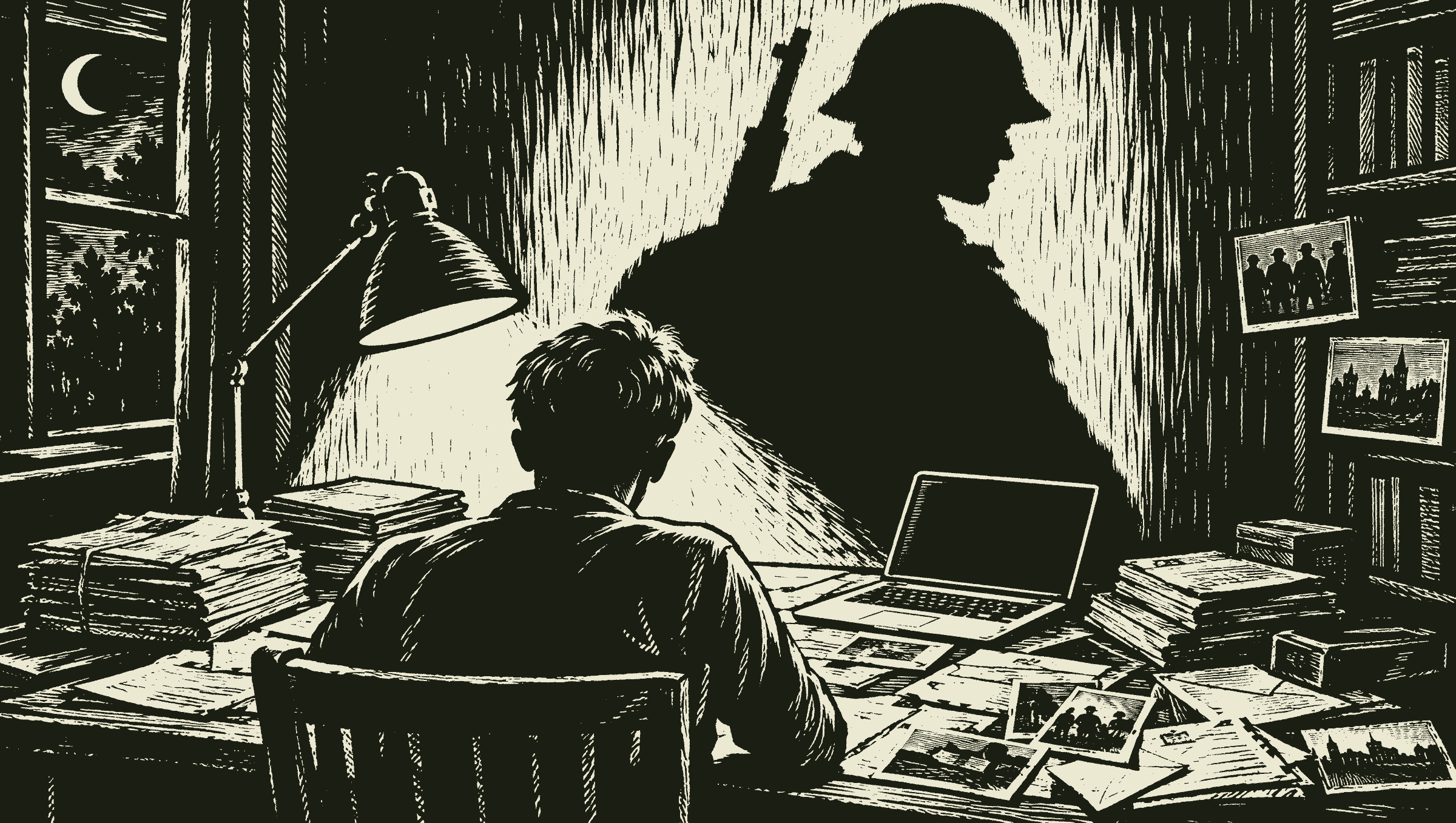
Why would a teenager give so much of his time to a great-great-uncle who died long before he was born? His own life may have something to do with it.
Hayden was born in Ireland, lived in the United States for five years, and now lives in Slovakia, the home of his mother Lucia. Like Sarsfield, he has had to start again in a country that wasn't his own.
He's also a rifle shooter. In 2026 he became the first non-national to win the Slovakian National Rifle Shooting Championships. He is now part of the Slovak National Team, and he hopes to shoot at the Olympics.
397.9
99.3 98.2 100.5 99.9
His four series that morning in Košice, from the board behind him.
So when he read the line on the Army form that said Sarsfield had qualified as a marksman with the M-1 in October 1942, he knew what that took.
| Sarsfield | Compared | Hayden |
|---|---|---|
| Ireland, 1905 | Born | Ireland, a century later |
| At 19, to America | Crossed the Atlantic | As a child, for five years |
| Michigan and Florida | Made a life | Slovakia |
| The US Army, in a world war | Stood for | The Slovak National Team |
| Marksman, M-1, 1942 | The rifle | National champion, with Olympic hopes |
Two Irish-born boys, a hundred years apart, each went abroad and made their own way. One was remembered for a single mistake. The other went looking for the rest of him.
XII 1905 to 1978
Who he was
He had a plan.
At 20 he was doing menial work on a factory floor, so that he could take industry home to Ireland.
He made a young man's mistake.
He was 21, and the charge was dismissed. He lived another fifty years.
He was loved.
His five sisters adored him and stayed angry on his behalf for decades.
He wrote home.
From a war in North Africa, he wrote to his mother.
He served.
At 36 he was called up, and he went. He spent over three years in a war far bigger than any family quarrel, earned a Good Conduct Medal and lost no days.
He taught.
The Army didn't only give him orders. It made him an instructor and a sergeant.
He worked.
He was a rigger, on heavy equipment, for more than thirty years.
He made people laugh.
Small, kind and funny, in pink socks. That is what the people who met him remembered.
So here is the sentence again
The son of an important man went to America to learn what Ireland needed, got caught with whiskey at twenty-one, saw the charge dismissed, went to war at thirty-six, lost no days, wrote to his mother, worked thirty years as a rigger, made people laugh in pink socks, and was disowned found.
Hayden's message to Sarsfield
Sarsfield, if you were to see this, I would just like to say that you were an inspiration to me, and by far had the coolest story of any family member in my opinion.
I really think people misunderstood you, and that there was much more to you than just "bootlegging", and that you really seemed to have turned your life around.
Hayden
The search isn't over.
Three lives on one line
Sarsfield's life, the world around him, and Hayden's search for him.
The archive
Every record Hayden has gathered so far, with what it proves and what it doesn't.
No records match that search. Try a place or a year.
Still open
The file isn't closed. These are the next leads, most important first.
Can you help?
If you recognise a name, a face or a place, or you hold a letter or photograph, tell Hayden. A date on an envelope can be the thing that joins two records.
About and method
A family project with one rule: show the working.
Finding Sarsfield is a family record of Sarsfield Patrick Smiddy, built from the research of his great-great-nephew Hayden. It aims to restore a whole person. It doesn't claim he was perfect.
"Behind the military records, medals and documents was a real person with a complicated life and a family history that could easily have been forgotten."Hayden, on what he wants you to take away
What the stamps mean
A primary record or a report from the time says it.
A reliable later source, or two sources pointing the same way.
A family member recalls it. That matters, and it isn't the same as proof.
It fits the evidence, but a key source is missing or the reading is uncertain.
Sources disagree, and both are kept in view.
Nobody knows yet.
House rules
- Family memory is always named as family memory.
- What a regiment did isn't assumed to be what one man did.
- Hayden's words are his own. Only spelling and punctuation have been tidied.
- Medical details and identity numbers stay out of the public site.
- The engraved plates were made with AI for this site. They are illustrations, and they are never presented as evidence.
- When new evidence changes something, the change is recorded below.
What changed in this edition
Some of the newspapers below were found in the Internet Archive and the National Archives catalogue while this edition was being built, so Hayden hasn't checked them yet.
- Added: the 1926 Detroit News interview and his May 1926 portrait, which is the same photograph the Post reused in 1927.
- Added: a chapter on Timothy Smiddy's career, and Hayden's own background.
- Raised to Documented: all six awards, including the Arrowhead and three service stars, from the Army's letter of 8 June 2026.
- Added: a set of engraved plates, made with AI from the sources described in the story.
- Retold: his life now runs in order as one story, with Hayden's search woven through it.
- Added: he pleaded not guilty, and was back in Washington with his family by May 1927.
- Added: the 40th Engineers' arrival at Oran on 22 June 1943 and their landing on the Cent beaches, from the Army's official history.
- Flagged: Sagarra's 2018 reference to a "prison sentence" conflicts with the dismissal.
- Corrected: a 2014 Irish Times article places the smuggling in Montana, citing the Helena Independent. Every report from the time says Detroit.
- Sarsfield's Army job corrected from Pioneer to Pioneer Instructor, as typed on the form.
- Added: the charge was dismissed on 6 August 1927. Earlier versions ended at the arrest.
- Added: Sarsfield's own words from the New York Times, and his 1927 newspaper photograph.
- Chrysler confirmed as his employer in 1925 to 1927, from his own statement. Ford remains a possibility for later years.
- The speeding incident moved from "three months later" to six weeks after the arrest, on the Post's dates.
- Good Conduct Medal, campaign medal, Marksman badge and lapel button raised to Documented, because they are on the 1945 record.
- Staff Sergeant dated to 17 September 1945. He served as a Sergeant before that.
- North Africa kept as a place he served, but not as a campaign credit. He arrived in June 1943, after the Tunisia campaign ended, and it isn't on his record.
- The Clonakilty source corrected from a register to a printed list in the college's centenary book.
- The 1922 photograph's caption reread as probably "Old Colwyn" rather than "Old Cobh".
- His wife's name flagged: the death certificate says Florence B. Stevens.
With thanks
Professor Eoin O'Brien, Tona O'Brien and Eda Sagarra. The US National Archives, the Department of Veterans Affairs, the US Army, the Michigan courthouses, MyHeritage, the Internet Archive, and the many people on Reddit who helped a young researcher read old forms.
Privacy and copyright
Newspaper reports are shown for family history and research. Family photographs belong to the family. If you hold rights in anything here, or would like something removed, use the form on the Still open page. This site asks search engines not to list it.